Table of content

This concrete stair calculator lets you estimate how much concrete is required for building steps or staircases. Enter the dimensions of each step and instantly calculate concrete volume for your project. It works for residential stairs, outdoor steps, and general staircase construction planning.
You can use this concrete stair calculator to get a fast estimate for a staircase, porch steps, or outdoor concrete steps. Just enter the basic dimensions of your stair layout, and the tool will calculate the total concrete volume needed for the job.
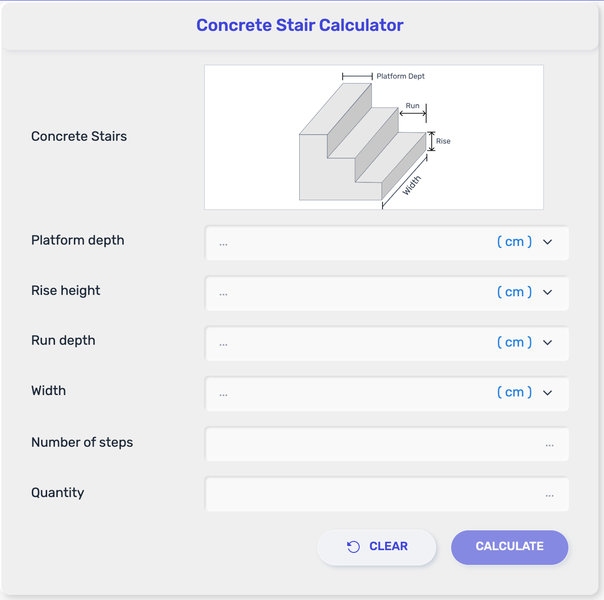
Enter the total number of steps in your staircase.
Fill in the dimensions for each step, including the rise, run, and width.
Choose the unit of measurement that matches your project.
Click the Calculate button to process the numbers.
Review the estimated concrete volume shown for the full staircase.
After you get the result, you can use it to plan materials, estimate cost, and prepare for pouring. For better accuracy, double-check all measurements before calculating, especially if you are working on a larger concrete staircase project.
This concrete steps calculator is built for quick estimates across many common stair projects. It gives users a simple way to check how much concrete may be needed before ordering materials or planning the next stage of the job.
It can be used to calculate concrete for:
Standard concrete steps for house entrances
Outdoor garden steps
Porch and patio stairs
Basement entry stairs
Garage access steps
Straight concrete staircases for residential projects
Small renovation jobs with replacement steps
New stair builds that need a fast concrete estimate
The tool works best when you already have the main stair dimensions, such as the number of steps, rise, run, and width. Based on those inputs, the concrete staircase calculator estimates the total concrete volume for the full stair structure. That makes it useful for both homeowners and contractors who want a quick number for planning.
For stair layouts with landings, uneven step sizes, or more complex shapes, it is better to calculate each section separately to get a closer estimate.
Once you enter the stair measurements, the calculator shows the total concrete volume needed for the project. This gives you a quick estimate for the full set of steps, not just one step.
Here’s what the result tells you:
How much concrete you need for the staircase based on the dimensions entered
What unit the result is shown in, such as cubic feet, cubic yards, or cubic meters
A practical estimate you can use for material planning, budgeting, or ordering concrete
You can use this result to:
estimate how much ready-mix concrete to order
compare project size before construction starts
prepare material planning for porch steps, entry stairs, or larger staircase jobs
A few things to keep in mind:
the number shown is usually an estimate, not a final order quantity
many users add a little extra concrete for waste, spillage, or small on-site adjustments
if your stairs include landings, uneven step sizes, or custom shapes, each section should be calculated separately for better accuracy
So, instead of giving a random volume number, the concrete stairs calculator gives you a result you can actually use during planning and construction.
A concrete stair calculator gives a solid estimate, but the final number is only as good as the measurements you enter. A few small mistakes in rise, run, or width can change the total volume more than expected, especially on larger stair projects.
To get a more reliable result, pay close attention to these points:
Measure every part carefully
Check the total stair width, step rise, and step run before entering anything into the concrete steps calculator. Even a small measuring error can affect the final concrete estimate.
Use the same unit throughout
Keep all values in one system, such as inches, feet, or meters. Mixing units is one of the most common reasons a concrete staircase calculator gives the wrong result.
Count the number of steps correctly
Make sure you enter the full number of steps in the staircase. Missing one step can throw off the total volume and lead to ordering less concrete than needed.
Check whether each step has the same size
The calculator works best when all steps follow the same dimensions. If your stair design includes uneven steps, split landings, or custom sections, calculate each part separately.
Add extra for waste
Many builders add a small margin for spillage, uneven ground, or minor changes during pouring. This is especially useful when you calculate concrete stairs for outdoor projects or larger pours.
Look at the full stair shape
Some stairs are simple straight runs, while others include side walls, landings, or thicker base sections. A basic concrete calculator for stairs may only cover the main stair volume, so extra structural parts may need separate calculation.
Accurate inputs lead to a more useful result. When the dimensions are correct, the concrete calculator for steps becomes a practical tool for estimating materials, comparing project size, and planning the next stage of the job.
Use this section to show the basic calculation behind the tool without turning it into a long math explanation. Keep it short, practical, and easy to scan.
Concrete volume = stair width × total stair run × average stair height
For stair layouts made of individual steps, the calculator may total each step section automatically and combine them into one final volume. If the staircase includes a landing, that part should usually be calculated separately and added to the total. The result can then be shown in cubic feet, cubic yards, cubic meters, or liters, depending on the unit selected in the calculator.
Concrete stairs may look simple, but the construction process requires careful planning and execution to ensure strength, safety, and long-term durability. If you’re using a calculator to estimate materials, it also helps to understand how those numbers translate into real construction.
1. Planning the layout
The first step is calculating the total rise and run to determine the number of steps. This ensures each tread and riser is consistent, which is critical for both safety and comfort.
2. Building the formwork
Once the layout is set, builders create formwork to shape the stairs. These molds must be strong and well-supported, as wet concrete puts significant pressure on them during pouring.
3. Adding reinforcement
Steel reinforcement (rebar or mesh) is installed inside the formwork. This step improves structural strength and helps prevent cracking over time, especially in outdoor conditions.
4. Pouring and finishing concrete
Concrete is poured into the forms, then leveled and compacted to remove air pockets. The surface is finished depending on the use—brushed for slip resistance or smooth for a cleaner look.
5. Curing for durability
After pouring, the concrete must cure properly. This stage is essential for achieving full strength and preventing early damage.
If you want to visualize how all these steps come together, this video shows the full process—from setting up the formwork to pouring and finishing the stairs:
Yes. It can be used for a few simple concrete steps or for a full staircase, as long as the dimensions are entered correctly and each section is included in the estimate.
Measure the stair run first, then calculate the landing as a separate slab section. Add both parts together to get the total concrete volume for the full layout.
Many people add a small extra amount to cover waste, uneven ground, or minor variations during the pour. This is especially useful when ordering ready-mix for a stair project.
Use one unit system consistently from start to finish. You can work in feet, inches, meters, or centimeters, but the measurements should match before calculating.
Some tools can show the result in liters as well as cubic feet, cubic yards, or cubic meters. This is useful for smaller jobs or when comparing bagged concrete quantities.
Concretestepcalculator.com is designed to help homeowners, builders, and contractors estimate the materials and dimensions needed for constructing concrete steps with greater accuracy and confidence. Whether you are planning a small residential entryway or a larger outdoor staircase, this tool simplifies the calculation process and supports better project preparation.
This tool was developed by the Concretestepcalculator.com team, with contributions from developers, researchers, and content specialists committed to creating practical, reliable, and easy-to-use calculators for construction and home improvement projects.
We are committed to providing reliable, easy-to-use calculation tools while maintaining transparency and protecting user privacy.
Concretestepcalculator.com does not require user registration or collect personally identifiable information. All inputs are used solely to perform calculations and are not stored or shared.
This tool provides estimates based on standard construction formulas and the values you enter. Actual material requirements may vary depending on design preferences, site conditions, local building codes, and construction methods. For precise measurements and safety compliance, consulting a qualified contractor or engineer is recommended.
By using this tool, you acknowledge that the results are for informational and planning purposes only. We are not responsible for any decisions or outcomes based solely on these estimates.
We may update this Policy from time to time to reflect improvements or changes to the tool. Any updates will be posted on this page to ensure continued transparency.